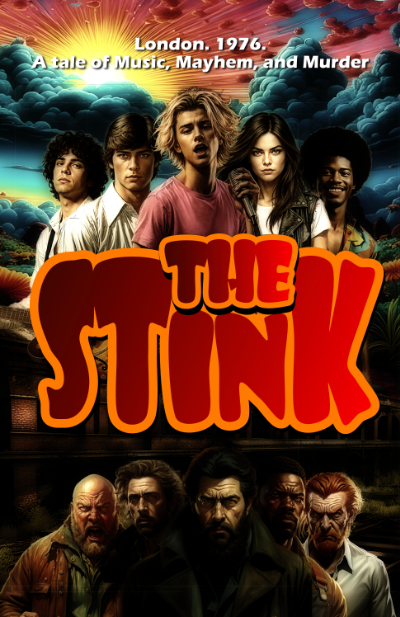
The battle is on. Authors and creators of all types are sharpening their pens to fight the evil that is Artificial Intelligence. It steals from us; it takes away our jobs; it undermines us; and … and yet, hypocritically, we use it too! Like I have for the article image. (Sorry).
How can we not? It is useful! If you are a broke author who cannot afford an illustrator, you will use AI to make your book cover. You will use systems like ProWritingAid and Grammarly, both of which use AI to some extent, to correct your grammar. You might use it to check you are not accidentally plagiarising someone else’s work, while complaining that the same system has had the gall to learn from your books without your permission (which is how it learnt to check for plagiarism … never mind). Let’s face it, the sudden growth in AI in the last few years has turned the writing world on its head, and it has made hypocrites of us all.
But it is still useful. So, can an author use AI without being accused of cheating? Or losing friends. Of course they can. In this snippet of an article, I will lay out how I am using AI to help me put the finishing touches to my mammoth writing project. But first …
What I am NOT using AI for
I have areas in my writing where using AI would make me uncomfortable. But not only that, there are areas where I think it is simply unsuitable. AI can summarise a plot. It can even come up with one by summarising a million plots it has absorbed before and creating something that fits a brief. It can look at your manuscript and “have an opinion” about your characters, your bias, your style, and so forth.
But it cannot understand your story. Not like a human does. And that is because it isn’t human. And it never will be. There, that’s my prediction. There won’t be a day when AI can not only impersonate a human but becomes one. Even if it gains sentience (oh look, a flying pig) it won’t be a human. It will be its own sentient being. Interestingly, it will probably be the first (and last) alien we will ever meet.
When we tell a story, we tell it for other humans. We express it for creatures who think like us, react like us, and culturally understand us. This applies to all humans from all traditions around the world. We might have different beliefs, different rules, different objectives, but those are superficial. We all think in the same way; we all cry at the same things, and we all laugh when another of us falls over their own feet.
And so, when one human reads something written by another human, they instinctively understand the story at a level that is far deeper than anything AI can do. They will know which of the words is most important to that moment, to that character. They will know how a character will react to a given situation before it even happens. They are able to analyse something by comparing the situation to themselves: “If that were me, I would look behind the curtain.” And they can do that all important reading-between-the-lines trick. AI can’t do that, not like a human does, because it isn’t human.
So, I won’t ask AI to come up with a plot for me. I won’t ask AI to build a world for me. I won’t ask AI to develop characters for me. I want those to be designed by a human, not a non-human. And if I want to call myself the “author” legitimately, it had better be me who does it. Otherwise, I am just a scribe working on the behest of someone else’s cleverness.
What Will I Use AI For?
Having banned AI from going anywhere near the creative backbone of my books, where will I let it into my life?
AI is a tool, at the end of the day, and some versions of AI, like ChatGPT and Gemini, are extremely versatile. Others are far more restricted, designed for a specific function. The AI used by Grammarly or Copilot on Windows are good examples of this.
Grammar Checking
Now, I don’t use Copilot, so I will leave that alone, but I have used both Grammarly and ProWritingAid as add-ins to MS Word. They are, umm, promising. There, that is me being kind. When it comes to checking grammar and spelling, they tend to be very good. They are not bad when it comes to structure, though I notice that neither understands the joy of alliteration. Currently, neither is very good at learning from the writer. They rely on a plethora of settings that you set up, normally online (which is a pain because they don’t work if you are off line!)
I can see how this is useful in a business world, especially trying to find consistency between team members, but I am not a team; I am a sad little author in my studio, staring at the Atlantic Ocean. (Hence the woolly hat).
So although I use (currently) ProWritingAid’s various reports and peek at it’s “rephrasing” suggestions occasionally for inspiration, mostly, I just use it to check that I haven’t written its and not it’s in the wrong place.
For anything cleverer, it is off to the chat AIs for me.
ChatGPT and Memory
I will stick to ChatGPT simply because it is what I use, but I suspect that most of this applies to all the Chat based AI systems. Also, for your notes, I am signed up on the OpenAI website and am using the free account. For what I am doing here, that is enough.
Before I go farther, I need to talk about limitations. And in this case, document size. To do the editing I am currently working on, it would really help if I could upload the current manuscripts to ChatGPT (I will explain why shortly). But I can’t. Even on the paid version, there is a limit to the document sizes, and 200,000 word docs are around 195,000 words too big. The creators of AI are clearly not authors and think everyone only writes 500 words at a sitting. Miserable bunch!
ChatGPT has a memory, which you can switch on through settings somewhere. This memory remembers what you used it for previously. Why is this a good thing? Let me give a very simple example. I use the Saxon word “dweorg” for dwarf (fairytale variety). The plural is dweorgas, and NOT dweorgs. That is because it is Saxon, not English, and different rules apply.
This kind of word completely messes up Grammarly et al because they don’t understand that dweorgas is a plural and insist on treating it as a singular. However, when I was messing with ChatGPT, and had given it some text to see what it could do, it asked me, “Should I do this for all dweorgas or just this dweorg?” I had used dweorgas in an earlier text and it worked out that it must be the plural of dweorg. That was a lightbulb moment for me. And that is when I discovered the memory functions.
Really, they are blindingly obvious. ChatGPT works because it is “trained,” and you cannot train something unless it can remember. What I had assumed in my complete ignorance of this kind of AI was that training was some high-level function done by the big companies by controversially scanning published works everywhere. And probably some clever programming, which my brain would object to.
But I was thinking far too narrowly. Your instance of ChatGPT can be trained by you for your uses. How? Well, I didn’t have the foggiest, and when I tried Google, I fell straight down a whole warren of rabbit holes. (Ironically, most were badly written.) So, I asked someone. I asked ChatGPT. “How,” I asked, “can I use you to help me edit my book?”
“Easy,” said ChatGPT, and immediately gave me a quick course on creating “primers,” “drop in cards” and generally giving the system parameters to work with. For editing a whole book, for instance, because you cannot upload the entire manuscript, but only chapters (or half ones in my case), it helps if ChatGPT knows what is going on. So, you can create primers:
- A character list with details of what accent a character might talk in, any common phrases they use, any quirks.
- A quick geography (non-visual) of main towns, or rivers, or whatever comes up a lot.
- A concise plot synopsis.
- A Glossary of terms or unusual words (vital in fantasy).
Basically, you can train it on your book in exactly the same way as you might brief a human editor. You are not asking it to be the creative because you (the real creative) are setting the rules.
Asking ChatGPT to help with training
If this sounds suddenly complicated (and yes, it can be), help is not far away. ChatGPT is very good at writing primers and drop in cards. Remember, these are only internal working, they are not your published work, so you are not cheating and getting ChatGPT to write your book for you.
Here is an example of how it can help. I have a very old character who sounds like he just fell out of a Shakespearean play. He doesn’t speak in verse, but he tends towards the thees and thous, if you get my drift. But how much should he? So, me and ChatGPT played. (Okay, it felt like we were playing, and I am aware that ChatGPT isn’t sentient!) I wrote a line which I felt was right stylistically. I then asked ChatGPT to correct it (my thee and thou grammar is a bit weak). We then applied that to another line.
I felt I could go a little more archaic. Were there words from the Elizabethan era I should be using? For instance, they used Yet, rather than But. But some were too much for me. “Marry” is used as an exclamation frequently. For instance, “Marry, it would be a fine thing!” But I felt that in the context of the rest of my book, where most characters speak in modern English, this could be confusing.
After a lot of messing around, I felt I had the balance right. I could now write a line and get ChatGPT to check me for consistency, etc. Basically, check that I was sticking to my own rules. I even told it to check me and then come up with an alternative each time I asked. Quite often I have ended up using a mix between my first idea and the alternative. One warning: this hasn’t sped up my writing . Actually, it has slowed it down, but it has improved it.
ChatGPT then asked if I would like a summary of the rules. It created a neat few paragraphs and bullet points which I could use in two ways: Firstly, a reference for myself, and secondly, a drop in reference or card that I could use to make sure ChatGPT stuck to our original rules (I notice it can wander!). This also meant that if I started a new chat, I could paste this in first so it knew what I expected of it.
Multiple Chats
I have now created multiple chats for double checking several different characters, each of whom has their own dialect, cadence, and tone when they speak. Usefully, if the style changes over time (and that has happened with one character in particular) ChatGPT has asked should it apply this to earlier checks it made. This was very useful, except I didn’t know where in the books they should go immediately. (And it is a complete pain that I couldn’t upload entire manuscripts because ChatGPT couldn’t tell me either.) So now, when I give it a line to check, I put a book number and chapter number next to it for future reference!
I have also asked it to print me out a compendium of edited lines as a reference. Very useful!
I am a great user of OneNote, and I use it together with ChatGPT. They are not intelligently linked (that is yet to come in the AI world in a way that works properly), but I keep all the notes and drop in cards in OneNote together with my original character breakdowns. I am slowly building a library of references outside of the AI world which I have built using AI as well as links to useful websites and so forth researched in the old-fashioned way. (Wow! Search engines are old fashioned now?)
The above use of ChatGPT has been at the core of my working. But I am going to expand it, especially when it comes to dialogue and languages. I want to try and create a new language using ChatGPT (or enough of a language to use between a couple of characters in conversation). Again, it will be me directing the creativity, but using ChatGPT to keep me consistent and ask for examples of language systems that we might steal from.
Would I like to see greater integration? Allowing for privacy issues, yes I would. AI like this can do things, under instruction, that I find hard. For instance, to my horror, I accidentally changed the eye colour of a less frequent character between two books. If AI had access to all the books I am working on, I could train it to look out for inconsistencies like that in the background. And unlike more traditional software, I wouldn’t need to list in fine detail what to watch out for; I could just tell it to check for inconsistencies.
Who is in charge?
This is the most important question, and it makes the difference between using AI to be lazy, cheat, or simply do your work for you, and you being in control of your output, and of continuing to grow as a writer.
When you ask AI to “write an email to John giving him the details of the meeting,” you are NOT in charge. You might be instructing AI to write the email, but it will decide the style, language, the amount of detail, and so forth. For an author, that is a stupid way to work.
I never ask AI to do anything like that. But to instruct AI to look over my shoulder while I do the actual work, to train it to be a second version of ME (and one with a better memory than I have), that works well. I have total control of the creative output, still put in the hours, but am writing with a safety net. And after all these years, my brain is rotted enough to need one.
That works well with writing. It is not so easy with images or video. Newer releases of image AI like Nano Banana Pro from Google, or GPT 1.5 from OpenAI are getting better at understanding detailed prompts. But they’re still not great. You can’t “chat” to those systems in quite the same way, and corrections can be a minefield.
As an example, I asked Gemini how I should write a prompt to create the picture of a boat with two masts and triangular sails. Getting AI to help write prompts is meant to be a clever use of chat AI. I gave it all kinds of details and references to real boats, and it came up with a nice, concise prompt. (Concise is important with image creation as the engines tend to see the beginning of the prompt as more important than the end. The longer the prompt, the worse that becomes.)
So, with my new prompt in hand, I thought I would try it on Gemini itself. It produced a boat with one mast and a square sail from its own prompt, the stupid thing. As I said, it has a long way to go!
I do use it for some image work, but like with writing, I try to stay in charge as much as possible. I now do an initial sketch, as well as I can (and I am no artist), then will tell AI to “improve this pen and ink drawing.” Normally, it produces a nicer drawn version of my exact sketch, with little or no surprises. I can then load that into Affinity Designer, mess around with it a bit more, and then throw it back at AI and ask it to produce a better, colour illustration. Once I am happy with that, I can then ask it to pose it how I wish. It is not perfect, and it does try to take control and add things I didn’t ask for, but it is getting there. I might not be doing the final drawing, but I created the original sketch — I haven’t stolen it from someone else. That is important to me.
So far, with my use of AI, I am still the author, and it is vital that I remain the author into the future. I am unhappy enough already that AI can potentially put me out of work as a voice actor; I don’t want to help it put myself out of work as a writer too!